Future-Proofing Your IT Infrastructure: Cloud vs. On-Premise Decisions
Strategic framework for choosing between cloud, on-premise, and hybrid infrastructure for enterprise organizations.
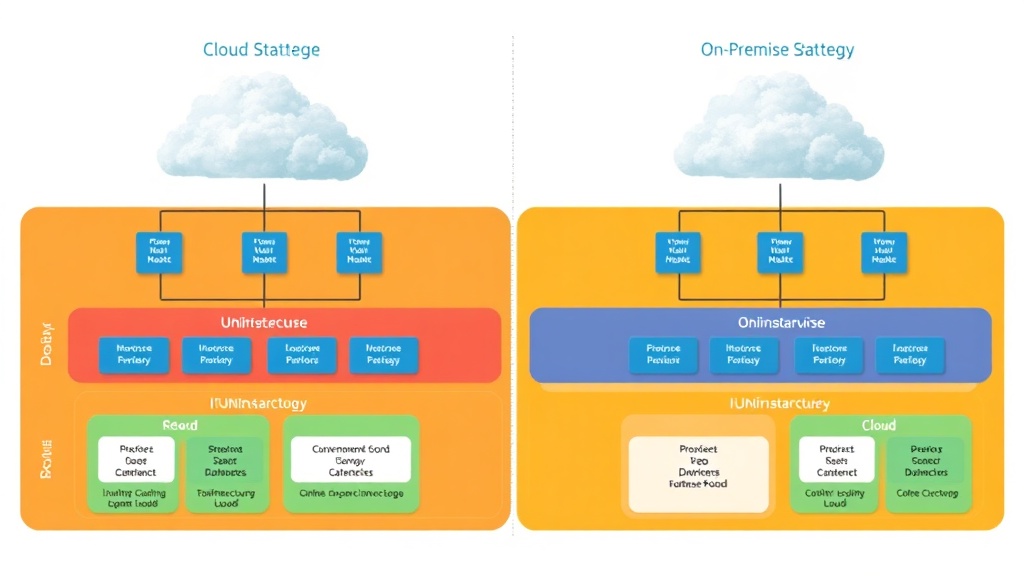
The cloud vs. on-premise debate has evolved. It’s no longer binary—it’s about building hybrid strategies that optimize for cost, control, compliance, and capability.
The Strategic Landscape
Cloud Advantages
- Elasticity: Scale up/down based on demand
- Operational efficiency: Fewer operational staff needed
- Capex to opex: No large upfront infrastructure investments
- Global reach: Deploy in any region instantly
- Built-in features: Backup, disaster recovery, security often included
- Innovation velocity: Access to latest technologies
On-Premise Advantages
- Control: Complete infrastructure ownership and control
- Compliance: Some regulated industries require data residency
- Performance: Zero-latency access for sensitive workloads
- Cost predictability: Fixed costs for predictable workloads
- Legacy integration: Some systems only integrate with local infrastructure
- Regulatory compliance: Some industries mandate on-premise infrastructure
The Decision Framework
Questions to Ask
1. Is this workload performance-sensitive?
- Real-time trading, manufacturing systems, ultra-low-latency services → On-premise or cloud in same region
- Standard business applications → Cloud acceptable with normal latency
2. What is the compliance requirement?
- HIPAA, PCI-DSS, FISMA → Can use cloud with proper architecture
- GDPR, CCPA → Cloud acceptable with data residency controls
- Some banking/telecom regulations → May require on-premise with exceptions
3. What is the workload pattern?
- Predictable, consistent load (ERP, payroll) → On-premise or reserved cloud instances
- Variable, spiky load (e-commerce, analytics) → Cloud with auto-scaling
- Temporary, project-based → Cloud
- Permanent, mission-critical → Hybrid approach
4. What is the cost profile?
- High utilization (>70% sustained) → On-premise often cheaper
- Variable utilization (<50% average) → Cloud usually cheaper
- Rapid growth (>20% YoY) → Cloud handles elasticity better
5. Is vendor lock-in acceptable?
- Risk-averse organizations → Multi-cloud strategy
- Innovation-first organizations → Single cloud often faster/cheaper
Modern Architecture Patterns
Pattern 1: Pure Cloud
When: Variable workloads, new applications, non-regulated industries
Approach:
- All applications in cloud
- Leverage cloud-native services (managed databases, serverless, containers)
- Disaster recovery via multi-region deployment
TCO: Typically 30-50% lower than on-premise for variable workloads
Pattern 2: Pure On-Premise (Legacy)
When: Mission-critical, ultra-low-latency, or highly regulated with data residency requirements
Approach:
- All infrastructure on-premise
- Cloud for overflow and disaster recovery
- Hybrid connectivity for burst capacity
TCO: 20-40% higher than cloud but provides maximum control
Pattern 3: Hybrid (Most Common)
When: Mix of new and legacy workloads, regulatory requirements with cloud optionality
Approach:
- Core systems on-premise (ERP, mission-critical applications)
- New applications in cloud (analytics, customer-facing, SaaS applications)
- Hybrid connectivity via Direct Connect / Express Route
- Unified management and security across both
TCO: Typically 15-25% lower than pure on-premise
Example hybrid architecture:
- On-premise: SAP, legacy middleware, database clusters (core business)
- Cloud: Salesforce, ServiceNow, analytics, disaster recovery copies
Pattern 4: Multi-Cloud Strategy
When: Large organizations want to avoid single-vendor dependency, need geographic distribution
Approach:
- Primary workloads on cloud #1
- Secondary workloads / burst capacity on cloud #2
- Potential: One cloud for IaaS, another for specialized services
- Unified observability and cost management across clouds
TCO: 10-15% cost premium for vendor flexibility
Emerging Considerations
Edge Computing
For organizations with distributed locations or remote users:
- Cloud-to-edge architecture keeps compute close to users
- Reduces latency for user-facing applications
- Example: Telco using cloud for control plane, edge for data plane
Serverless
For variable or event-driven workloads:
- Extreme elasticity and cost efficiency
- No infrastructure management
- Best for short-lived processes, APIs, event handlers
Containerization
For flexible, portable workloads:
- Container-based architecture reduces cloud lock-in
- Kubernetes enables multi-cloud portability
- 30-40% better resource utilization than VMs
Build vs. Buy in Infrastructure
Build (Manage Your Own)
- Highest cost
- Maximum control
- Requires specialized expertise
- 3-5% of IT budget typically
Buy (Cloud)
- Lower cost
- Less control
- Leverages provider expertise
- 0-1% of IT budget typically
Managed Services
- Middle path—cloud with premium support
- Good control with operational outsourcing
- 1-3% of IT budget typically
Bottom line: Unless you have specific control or regulatory requirements, buying (cloud) is more cost-effective than building (on-premise).
Implementation Roadmap
Year 1: Cloud for New Development
- All new applications target cloud
- Establish cloud governance and security baseline
- Begin reskilling teams
- Start planning legacy migrations
Year 2: Selective Migration
- Identify 20-30% of workloads suitable for early migration
- Execute pilots and proofs of concept
- Refine hybrid architecture
- Begin decommissioning duplicated on-premise systems
Year 3: Scale Migration
- Migrate 50-70% of workloads
- Achieve hybrid steady state
- Optimize cloud spend
- Sunset selected on-premise infrastructure
Year 4+: Optimization Phase
- Remaining 20-30% stabilized in hybrid model
- Continuous optimization and feature adoption
- Leverage advanced cloud services (AI/ML, data analytics)
- Update strategy based on business evolution
Expected Outcomes
Organizations executing disciplined cloud strategy see:
- 30-40% reduction in IT operational costs within 3 years
- 50-60% faster deployment of new capabilities
- 40-50% improvement in system reliability
- 3-5 year payback on cloud migration investment
The Bottom Line
The future isn’t purely cloud or on-premise—it’s hybrid and intentional. Choose infrastructure based on workload characteristics and business requirements, not ideology.
Let’s assess your workload portfolio and design your future-proof infrastructure strategy.
About This Article
This article is part of Grupo Cidelo's enterprise consulting insights series. We help organizations navigate complex transformations across business automation, enterprise sales, cloud infrastructure, and digital transformation.